


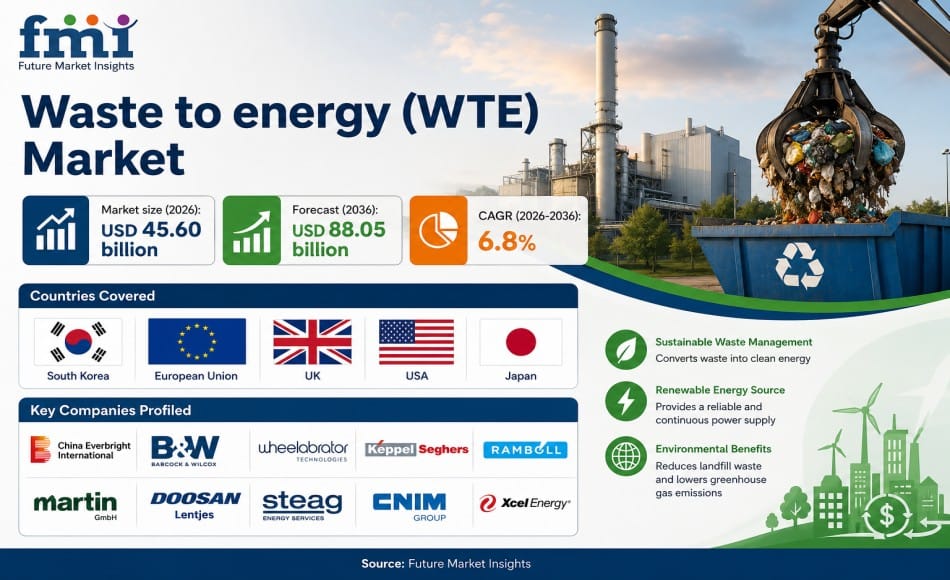
Future Market Insights forecasts that the global waste‑to‑energy (WTE) market will expand from USD 45.60 billion in 2026 to USD 88.05 billion by 2036, a compound annual growth rate (CAGR) of 6.8 %. The projection highlights accelerating infrastructure investment, tightening environmental regulations, and rising demand for sustainable energy recovery—factors that are directly relevant to municipal authorities, energy utilities, and firms that supply waste‑processing technology.
Future Market Insights Forecasts Global WTE Growth
The report values the 2026 market at USD 45.60 billion and identifies an incremental opportunity of USD 42.45 billion over the next decade. Solid waste accounts for 69 % of the market in 2026, while anaerobic digestion leads the process segment. Electricity generation and transport fuels are the primary applications, driven by municipal authorities and energy utilities that are expanding procurement of advanced conversion facilities.
Key growth drivers cited include:
- Landfill diversion and sustainable waste management – Governments and municipalities are adopting WTE technologies to reduce reliance on landfills and meet sustainability targets.
- Renewable energy and circular‑economy initiatives – Converting municipal solid waste, industrial waste, and biomass into electricity or bio‑fuels supports renewable‑energy mandates.
- Regulatory support and institutional procurement – Environmental regulations and waste‑management mandates across major economies are accelerating the purchase of advanced waste‑conversion equipment and the modernization of existing infrastructure.
Challenges noted are high capital costs, complex compliance procedures, technology integration issues, public concerns over emissions, and long project approval timelines.
Regulatory and Infrastructure Drivers
The analysis underscores that “environmental regulations and waste‑management mandates across major economies are accelerating procurement of advanced waste conversion technologies and infrastructure modernization.” Regulatory frameworks are prompting municipalities and utilities to prioritize projects that meet emissions standards and align with circular‑economy policies.
Infrastructure investment is a recurring theme. The report points to “expansion of anaerobic digestion and gasification facilities,” “growth of smart monitoring and AI‑enabled operational systems,” and “rising investment in advanced emissions control technologies” as emerging opportunities. Digital procurement models and direct‑supply arrangements are also gaining traction, suggesting a shift toward more transparent and efficient acquisition processes.
Regional Growth Leaders
South Korea emerges as the fastest‑growing region, posting a 6.5 % CAGR, followed by the European Union (6.2 % CAGR), the United Kingdom (6.0 % CAGR), the United States (5.8 % CAGR), and Japan (5.5 % CAGR). In South Korea, “infrastructure investment, regulatory enforcement, and expanding waste‑processing capacity are accelerating adoption of advanced waste‑to‑energy technologies.” The European Union’s growth is linked to “strong environmental regulations and circular‑economy initiatives,” while the United States benefits from “renewable energy initiatives, municipal infrastructure upgrades, and landfill diversion programs.”
The competitive landscape remains moderately consolidated. Global infrastructure operators and technology providers—including China Everbright International, Babcock & Wilcox Enterprises, Wheelabrator Technologies, Keppel Seghers, Ramboll Group, Martin GmbH, and Doosan Lentjes—compete on operational scale, process innovation, and regulatory‑compliance expertise.
Key Takeaways
- The global WTE market is projected to reach USD 88.05 billion by 2036, up from USD 45.60 billion in 2026, representing a 6.8 % CAGR.
- Solid waste (69 % share) and anaerobic digestion are the leading waste type and process segments, respectively.
- South Korea (6.5 % CAGR) and the European Union (6.2 % CAGR) are the fastest‑growing regions, driven by infrastructure spending and regulatory enforcement.
FinanceInsyte's Take
The forecast signals a sizable, multi‑billion‑dollar pipeline for firms that provide waste‑conversion equipment, emissions‑control solutions, and digital monitoring platforms. While capital intensity and regulatory complexity remain hurdles, the steady CAGR suggests a durable demand base. Executives should monitor policy developments in key regions—particularly South Korea and the EU—and assess how emerging AI‑enabled plant‑optimization tools could affect project economics and procurement cycles.
Source: Accessnewswire


