Quaise Energy, a leading developer of utility-scale superhot geothermal energy, today announced the first close of its Series B financing, raising $134 million with additional equity and debt capital expected to close imminently. The round was led by Prelude Ventures, with strategic investments from JERA and Idemitsu, two of Japan’s largest energy companies. Nearly all existing investors, including Safar Partners, participated in the round. The proceeds from Series B will fund Project Obsidian, the world’s first commercial superhot geothermal power plant, and the continued development and commercialization of Quaise’s millimeter wave drilling system towards depths in excess of 5 km. Project-level equity and debt financing is concurrently being raised as the company advances toward first revenues secured by yet-undisclosed commercial off-take partners. The Series B brings Quaise’s total funding raised to date to $230 million.
Quaise uses a millimeter wave drilling system developed at the Massachusetts Institute of Technology to ablate rock at depths and temperatures that are not economically accessible using conventional drilling. With this technology, Quaise has the unique potential to reach rock at temperatures of 300-500°C in most places worldwide, enabling the construction of geothermal systems that rival fossil and nuclear energy in power density and renewables in cost. “Our ambition is to power civilization with Earth’s most compelling energy source. This round takes us from field-proven technology to first commercial revenues,” said Carlos Araque, CEO and President of Quaise Energy.
$134 Million Series B Led by Prelude Ventures with Strategic Energy Investors
The Series B financing marks the first equity component of a broader capital program for Quaise Energy, which includes project-level capital and debt financing. Prelude Ventures led the round, with participation from JERA Co., Inc., Japan’s largest power generation company, and Idemitsu Kosan, one of Japan’s largest integrated energy companies. Nearly all existing investors, including Safar Partners, also participated. The funds will support Project Obsidian in Central Oregon and further development of Quaise’s millimeter wave drilling system, which targets depths exceeding 5 kilometers. Additional project-level equity and debt financing is expected to close later this year.
JERA, which generates one-third of Japan’s electricity, views millimeter wave drilling as a pathway to global baseload geothermal resources. “As a global energy company, JERA understands both the scale of the challenge ahead and the scale of the opportunity that next-generation geothermal represents. Millimeter wave drilling technology has the potential to make geothermal a truly global baseload resource,” said Takeshi Kodama, Head of JERA Ventures and Managing Partner, JERA Co., Inc. Idemitsu Kosan emphasized the technology’s potential to contribute to stable, sustainable power supply at scale. “Quaise’s millimeter wave technology has the potential to redefine what geothermal can deliver — accessing heat at depths and temperatures that were previously out of reach. This investment reflects Idemitsu’s commitment to next-generation energy solutions that can contribute to stable, sustainable power supply at scale,” said Kei Honda, Executive Leader, San Jose Office and Senior Vice President, Head of Corporate Venturing, Idemitsu Americas Holdings Corporation.
Safar Partners, an early investor in Quaise, highlighted the company’s transition from scientific breakthroughs to commercial deployments. “We are proud to be a partner and supporter of Quaise Energy. As the need for power grows exponentially around the world, Safar believes geothermal energy has a critical role to play, and Quaise is uniquely positioned to revolutionize the industry,” said Parinaz Motamedy, Partner at Safar Partners. “By reimagining the drilling process entirely and leveraging millimeter wave technology to reach previously inaccessible depths and temperatures, Quaise is unlocking superhot geothermal energy at a global scale. We’ve been working alongside the team since the beginning, and this round represents an important inflection point as the company transitions from scientific breakthroughs to commercial deployments.”
Millimeter Wave Drilling Technology Advances Toward Commercial Deployment
Quaise’s millimeter wave drilling system, developed at MIT, uses electromagnetic energy to ablate rock at extreme depths and temperatures. The technology has demonstrated the ability to drill over 100 meters through granite in Central Texas in 2025, achieving the first full-scale penetration of basement rock in field conditions. The company is now approaching one kilometer of depth at the same site, a milestone that could validate the system’s potential for commercial geothermal projects. This achievement represents the deepest penetration ever achieved with millimeter wave drilling — and the deepest ever recorded by any non-contact drilling technology. These results validate the core technology that Quaise will deploy at Project Obsidian and at other sites as the company dramatically expands the map for geothermal.
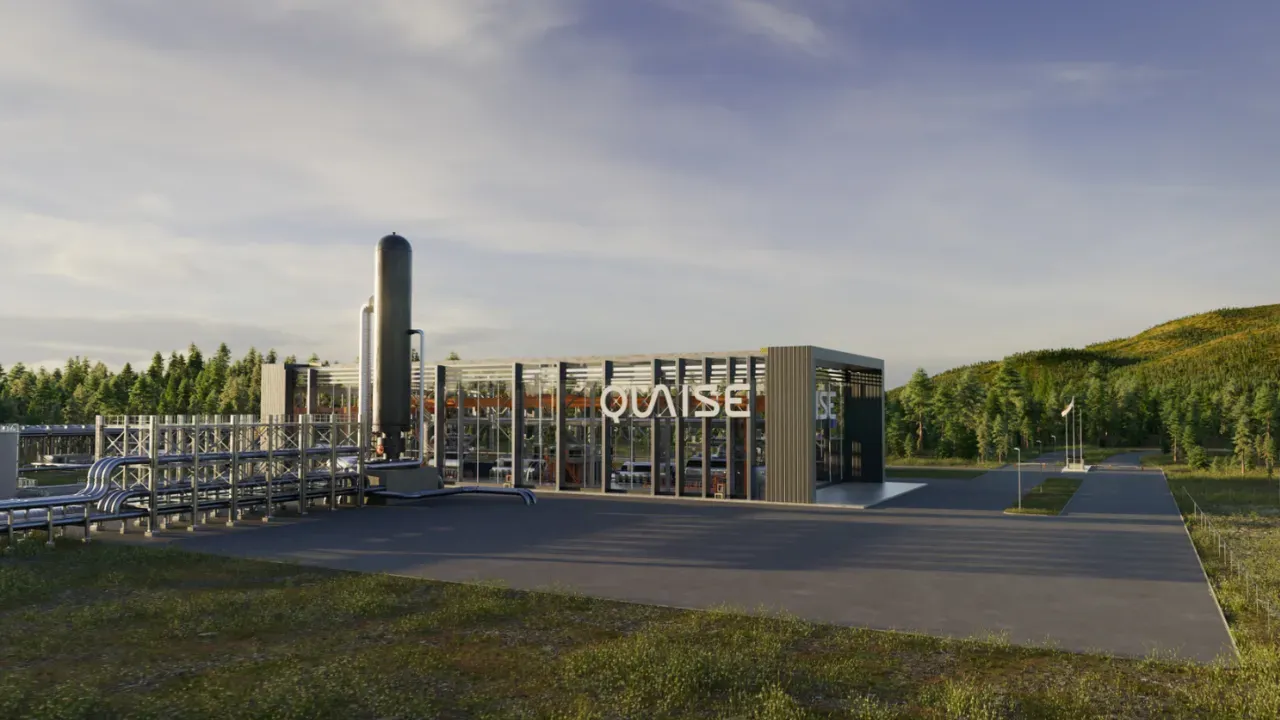
Project Obsidian, where construction is currently underway, sits on federal geothermal leases in the Deschutes National Forest in Oregon, one of the most studied geothermal locations in the United States. The project has gigawatt-scale potential and will deliver first electrons to the grid by 2030. Power will support grid stability across the Pacific Northwest at a time when the region faces rising demand and constrained transmission capacity. “We have backed Quaise since the beginning because we believed accessing superhot rock would unlock geothermal energy at a scale the world has never seen,” said Mark Cupta, Managing Director at Prelude Ventures. “What the team has achieved in the field and what they are now building at Project Obsidian validates that conviction, and we are proud to continue supporting Quaise as they move from proving the technology to powering the grid with clean, reliable energy nearly anywhere on Earth.”
Strategic Energy Partnerships Signal Global Geothermal Expansion Potential
JERA and Idemitsu Kosan’s involvement underscores growing interest in next-generation geothermal solutions. JERA, which generates one-third of Japan’s electricity, views millimeter wave drilling as a pathway to global baseload geothermal resources. Idemitsu Kosan emphasized the technology’s potential to contribute to stable, sustainable power supply at scale. Quaise’s approach could expand geothermal energy’s geographic viability, as superhot rock formations exist in most regions worldwide. The company’s focus on combining technology innovation with project development positions it as a unique player in the clean energy transition.
The $134 million Series B represents the initial equity component of a broader capital program. Quaise has closed $230 million to date. Additional components of the capital program, including project-level equity and debt financing, are expected to be announced later this year. Quaise Energy is unlocking the Earth’s deep heat to deliver clean, reliable, baseload energy at scale—almost anywhere in the world. As both a technology innovator and project developer, Quaise builds and operates solutions that harness superhot geothermal energy far below the surface, enabling power generation that can rival the output of today’s most efficient fossil fuel and nuclear plants. With its millimeter wave drilling technology, developed after more than a decade of research at the Massachusetts Institute of Technology (MIT), Quaise’s mission is to make superhot geothermal a backbone of the modern energy system, offering affordable, zero-carbon power and true energy independence for communities and nations everywhere.
Key Takeaways
- Quaise Energy raised $134 million in the initial close of its Series B financing, led by Prelude Ventures and including strategic investments from JERA and Idemitsu Kosan.
- The company’s millimeter wave drilling system has achieved full-scale field testing, drilling over 100 meters through granite in Central Texas and approaching one kilometer of depth.
- Project Obsidian, the world’s first commercial superhot geothermal plant, is under construction in Oregon and aims to deliver grid power by 2030.
FinanceInsyte's Take
Quaise Energy’s funding and technology milestones highlight the growing intersection of innovation and infrastructure in the energy transition. While the company’s progress is notable, the path to commercial viability remains uncertain, particularly given the technical challenges of scaling millimeter wave drilling. For financial stakeholders, the focus should be on how this technology integrates into broader energy portfolios and whether it can meet projected timelines for revenue generation. The involvement of major energy players like JERA and Idemitsu suggests strategic confidence, but execution risks persist in unproven markets.
Source: Businesswire