
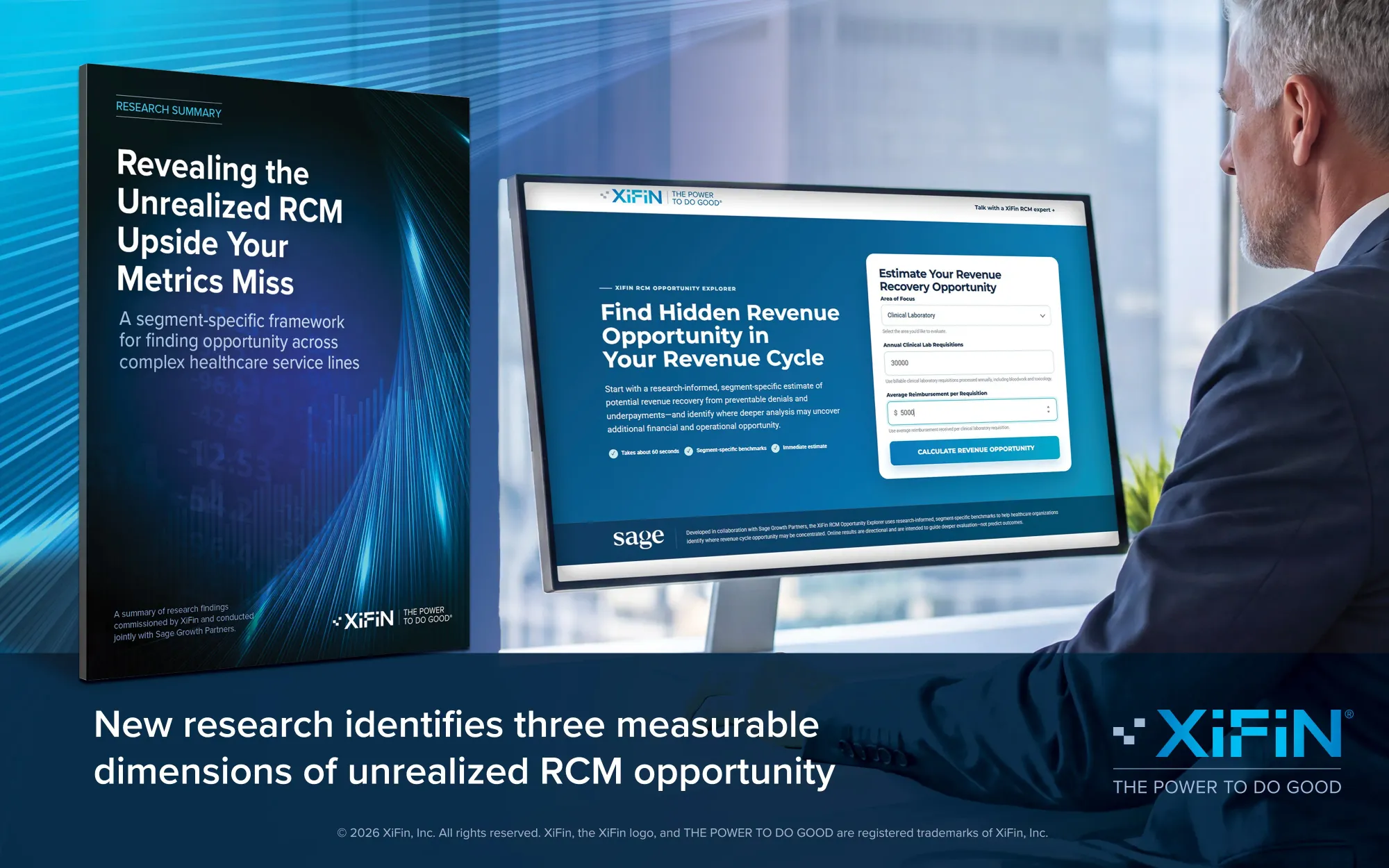
Healthcare organizations are facing intensifying financial pressures as reimbursement complexity, regulatory mandates, and rising patient financial responsibility create significant gaps in realized revenue. New research conducted by XiFin, Inc. in collaboration with Sage Growth Partners suggests that ancillary service providers—including radiology, pathology, and clinical laboratories—are losing substantial capital to preventable administrative friction and inefficient workflows. The study identifies three core dimensions of unrealized opportunity: Revenue Recovery, Operational Efficiency, and Patient Engagement and Access. By addressing these interconnected areas, the research indicates that mid-sized practices could capture millions in annual value that is currently being lost to denials, underpayments, and manual rework.
Quantifying the Ancillary Revenue Opportunity
The research brief, Revealing the Unrealized RCM Upside Your Metrics Miss, provides specific financial benchmarks to illustrate the scale of these losses. For a mid-sized radiology practice processing 350,000 claims annually at a $50 blended rate, the study identifies a total opportunity exceeding $2.6 million. This figure is comprised of $1.75 million from reducing denials and underpayments, $677,000 from operational efficiencies, and $214,000 from improved patient collections. Similarly, a mid-sized pathology practice submitting 210,000 claims at an average value of $108 per claim faces an approximate $870,000 annual opportunity. This includes $430,000 in recovered revenue from denials, $110,000 in cost savings from operational efficiencies, and $330,000 in additional patient collections.
XiFin suggests that when these findings are extrapolated to larger health systems managing multiple ancillary service lines, the combined annual opportunity could reach tens of millions of dollars. The research highlights that these losses are often driven by "preventable rework," manual processes, and the administrative burden of managing prior authorizations and appeals. The study argues that organizations often treat these issues as isolated problems, whereas they are actually interconnected drivers of financial performance. For instance, the No Surprises Act requires accurate good-faith estimates for uninsured patients; the company notes that failing to provide accurate estimates can directly impact an organization's ability to collect earned revenue and manage denials.
Leveraging AI to Mitigate RCM Friction
To address these identified gaps, XiFin is positioning its Empower AI capabilities as a method to automate high-friction workflows. The company is specifically targeting the complexity of the appeals process, which has historically required significant labor to research payer policies and compile clinical documentation. By using AI to reduce the time required for research and assembly, the company claims organizations can expand their appeal capacity without increasing headcount. One cited XiFin customer reported an 85% reduction in appeal completion and submission time, alongside a 60% reduction in related costs.
The research also emphasizes the role of AI in improving patient financial clarity at the point of entry. By synthesizing data regarding eligibility, pricing, deductibles, and co-pays, AI-enabled workflows can generate more accurate patient estimates. This is increasingly a compliance necessity under federal and state price transparency rules. To help providers quantify their specific exposure, XiFin has launched the XiFin RCM Opportunity Explorer. This interactive application allows organizations to input claim volumes and clinical specialties to receive tailored estimates of potential revenue recovery. The tool is designed to help leadership prioritize investments in automation and analytics by establishing a baseline of where revenue is currently at risk.
Key Takeaways
- Radiology practices with 350,000 annual claims may have an opportunity exceeding $2.6 million through improved denials management, efficiency, and collections.
- Pathology practices submitting 210,000 claims at $108 per claim could see an annual opportunity of approximately $870,000.
- AI implementation in the appeals process has reportedly enabled one XiFin customer to reduce appeal-related costs by 60%.
FinanceInsyte's Take
In our view, this research highlights a critical shift in how healthcare CFOs must view revenue cycle management: it is no longer just a back-office administrative function, but a primary driver of margin preservation. The data suggests that for ancillary services, the "leakage" is not just a result of bad debt, but a direct consequence of operational complexity and regulatory non-compliance. The link between the No Surprises Act and revenue collection is particularly telling; it demonstrates that regulatory accuracy is now inextricably tied to cash flow predictability. As healthcare providers face tighter margins, the move toward AI-driven RCM is less about "innovation" and more about a necessary defense against the escalating costs of manual administrative labor and the rising complexity of payer-provider interactions.
Questions & Answers
How does the No Surprises Act impact the financial performance of ancillary providers?
The Act requires providers to deliver accurate good-faith estimates to uninsured and self-pay patients. According to the research, failing to manage this complexity can lead to increased billing friction, higher denial rates, and a diminished ability to collect earned revenue.
What are the three primary dimensions of revenue cycle opportunity identified by the research?
The research identifies Revenue Recovery (addressing denials and underpayments), Operational Efficiency (reducing manual rework and administrative burden), and Patient Engagement and Access (improving financial clarity and collection performance).
Can AI effectively reduce the cost of the medical appeals process?
The research suggests that AI can reduce the labor required to research payer policies and gather documentation. One XiFin customer reported a 60% reduction in appeal-related costs and an 85% reduction in the time required to complete and submit appeals.
How can healthcare organizations estimate their specific RCM revenue leakage?
Organizations can use the XiFin RCM Opportunity Explorer, an interactive application that uses segment-specific benchmarks to provide tailored estimates based on an organization's claim volume, clinical specialty, and average reimbursement rate.
Source: Businesswire