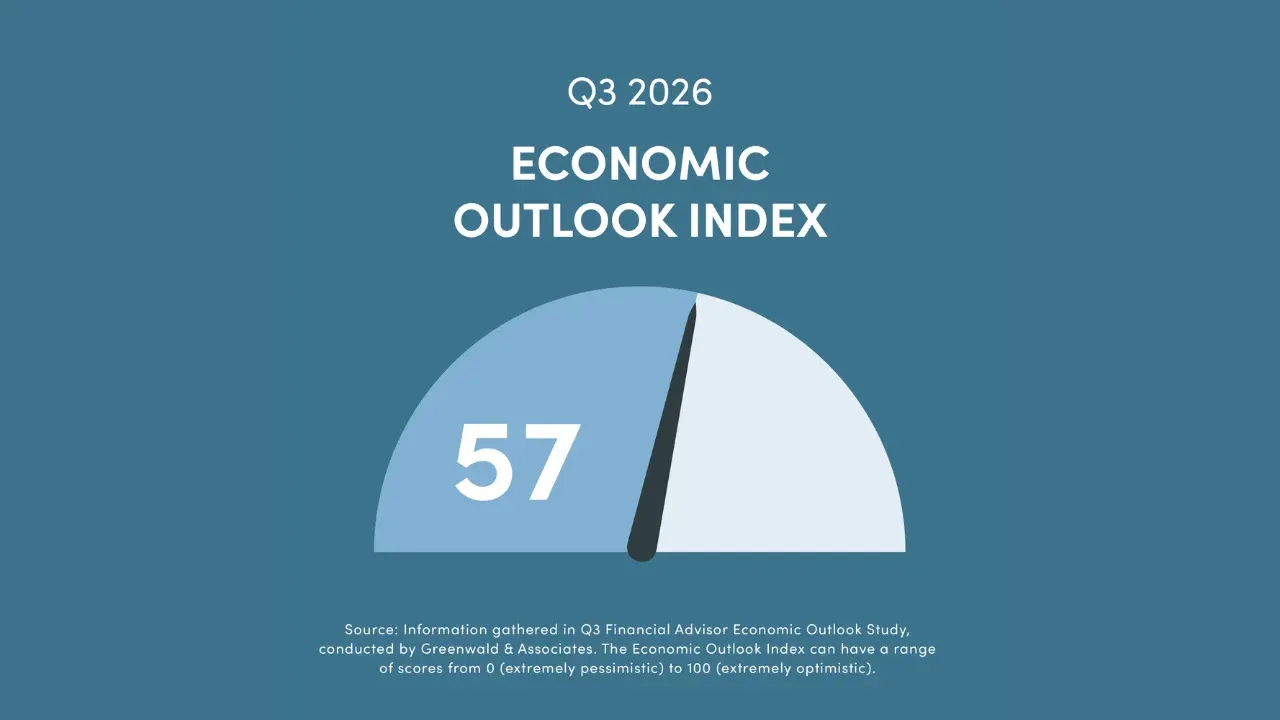
Financial advisors are shifting their strategic focus from recessionary mitigation to managing AI-driven client inquiries as macroeconomic anxieties begin to subside. Security Benefit’s Q3 Survey of Financial Professionals, conducted in partnership with Greenwald Research, reveals that the Financial Professional Economic Outlook Index climbed to 57, up from 55 in the second quarter. This uptick reflects a measurable improvement in sentiment regarding inflation and recessionary risks among professionals managing significant assets. However, the data suggests a new complexity in the advisor-client relationship: artificial intelligence is no longer just an internal productivity tool but a primary driver of client-led discussions. As 89% of surveyed professionals anticipate an increase in AI-related client inquiries over the next year, the industry is facing a fundamental shift in how financial information is consumed and validated within the wealth management ecosystem.
Rising Economic Optimism and Shifting Inflation Expectations
The third-quarter data indicates a notable cooling of the macroeconomic fears that dominated previous quarters. Specifically, inflation concerns among financial professionals dropped significantly; only 13% of respondents expected inflation to reach 4% or higher over the next 12 months, a sharp decline from the 24% reported in Q2. Instead, a majority of 60% now expect inflation to settle within the 3% to 3.9% range. This shift in sentiment is mirrored in recessionary outlooks, where 62% of professionals now see a low or almost non-existent likelihood of a recession occurring within the next year, compared to 56% in the previous quarter.
While the underlying economic outlook has improved, market volatility remains a critical variable for wealth managers. Justin Jacquinot, Senior Vice President and Head of IMO and RIA Channels at Security Benefit, noted that while advisors have become more optimistic, recent rate hikes have caused volatility to spike across both equity and fixed-income markets. Despite this, equity sentiment remains resilient, with 54% of professionals expecting the S&P 500 to gain at least 6% over the next 12 months. This suggests that while the "fear factor" regarding the macroeconomy is receding, the tactical challenge of managing volatility in a fluctuating interest rate environment remains a primary concern for client-facing professionals.
AI Integration Moving from Back-Office to Client Interaction
Artificial intelligence has moved beyond the experimental phase to become a core component of professional practice, with 85% of surveyed financial professionals currently utilizing the technology. The adoption is heavily weighted toward operational efficiency, specifically in meeting transcription and notetaking (49%), summarizing investment research (47%), and drafting client communications (43%). Perhaps more significantly for the capital markets, approximately 12% of advisors are now leveraging AI for portfolio construction, primarily focusing on asset allocation ideas and product research. The trajectory for this technology appears strictly upward, as 80% of respondents plan to increase their workplace use of AI, with zero respondents indicating an intention to decrease usage.
Crucially, the survey highlights a growing "information gap" between advisors and their clients caused by decentralized AI access. Currently, 45% of advisors report that clients frequently or sometimes bring AI-generated information into professional discussions. This trend is expected to intensify, with 89% of professionals forecasting an increase in these AI-driven inquiries over the coming year. This shift positions the financial advisor in a new role: rather than being the sole source of market intelligence, they are increasingly acting as a critical filter, tasked with providing context and translating raw, AI-generated data into actionable, long-term financial strategies that align with specific client goals.
Key Takeaways
- Security Benefit’s Financial Professional Economic Outlook Index rose to 57 in Q3, up from 55 in Q2.
- Inflation concerns fell to 13% for the next 12 months, down from 24% in the second quarter.
- 85% of financial professionals currently use AI in their practices, with 80% planning to increase usage.
FinanceInsyte's Take
In our view, the Security Benefit data signals a profound structural change in the value proposition of the financial advisor. For years, the industry's moat was built on information asymmetry—the advisor knew something the client did not. The fact that 85% of professionals are using AI, while nearly 90% expect a surge in AI-informed client questions, suggests that this moat is evaporating. The "information" is becoming a commodity, but "interpretation" is becoming a premium service.
We believe the real strategic battleground for RIAs and institutional wealth managers will not be the adoption of AI for productivity, but the ability to defend their expertise against the "hallucinations" or oversimplifications inherent in consumer-grade AI. As clients bring AI-generated data to the table, the advisor's role shifts from a provider of data to a validator of truth. Firms that fail to integrate AI into their own workflows will likely find themselves unable to compete with the speed and accuracy of AI-empowered peers.
Questions & Answers
How is the shift in inflation expectations impacting advisor sentiment?
The decline in inflation concerns—from 24% in Q2 to 13% in Q3 regarding 4% or higher rates—has contributed to a rise in the Financial Professional Economic Outlook Index from 55 to 57. This suggests a stabilizing macroeconomic outlook that allows advisors to pivot from defensive positioning to more growth-oriented discussions.
What are the primary ways financial professionals are currently utilizing AI?
The most prevalent use cases are administrative and research-oriented: 49% use it for transcription/notetaking, 47% for summarizing research, and 43% for drafting communications. Notably, 12% have moved into more complex applications like using AI for asset allocation and product research.
Why is the rise in AI-driven client inquiries a strategic concern for wealth managers?
With 89% of advisors expecting an increase in clients bringing AI-discovered information to meetings, advisors face a heightened need to provide context. The strategic challenge lies in translating potentially unverified or simplified AI data into sophisticated, long-term financial decisions, effectively moving the advisor's role from information provider to expert validator.
What does the survey suggest about the future of AI adoption in the industry?
Adoption appears to be permanent and expanding. With 80% of professionals planning to increase their use of AI and 0% planning to decrease it, the technology is becoming a standard component of the financial professional's toolkit rather than a temporary trend.
Source: Security Benefit