Q4 is attempting to consolidate the fragmented investor relations (IR) landscape by embedding advanced reasoning engines and automated voice agents directly into its core platform. The company, which manages IR for more than 2,600 public companies globally, is positioning its latest suite of enhancements to replace manual, spreadsheet-heavy processes with AI-driven market intelligence. By integrating consensus data and public guidance directly into its Q™ platform, Q4 aims to provide IR professionals with immediate clarity on sell-side expectations and analyst sentiment. This strategic move seeks to bridge the gap between disparate data sources—such as broker portals and shareholder ownership records—to create a unified environment for managing market perception and earnings execution.
AI-Powered Consensus and Guidance Intelligence
The company is targeting the high-stakes period surrounding earnings cycles by introducing AI-powered Consensus & Public Guidance intelligence. Historically, IR teams have relied on manual reconciliation of analyst estimates and revision trends across disconnected tools to understand market expectations. Q4 is attempting to automate this by leveraging its IR Agent™ to allow users to interact conversationally with market data. According to the company, newly published intelligence becomes available within the Q platform within five minutes, enabling teams to generate pre-earnings consensus summaries in minutes rather than hours.
This intelligence layer is designed to identify "expectation gaps" by comparing analyst estimates against a company's own public guidance. By doing so, Q4 suggests that IR teams can better anticipate potential challenges to their outlook from the Street. Furthermore, the platform aims to connect these expectations with actual investor behavior by overlaying analyst sentiment with shareholder ownership and trading activity data. This integration follows Q4’s earlier acquisition of Virtua Research, signaling a broader effort to centralize market intelligence and historical model variance within a single, reasoning-capable ecosystem.
Automating Earnings Call Execution and Management
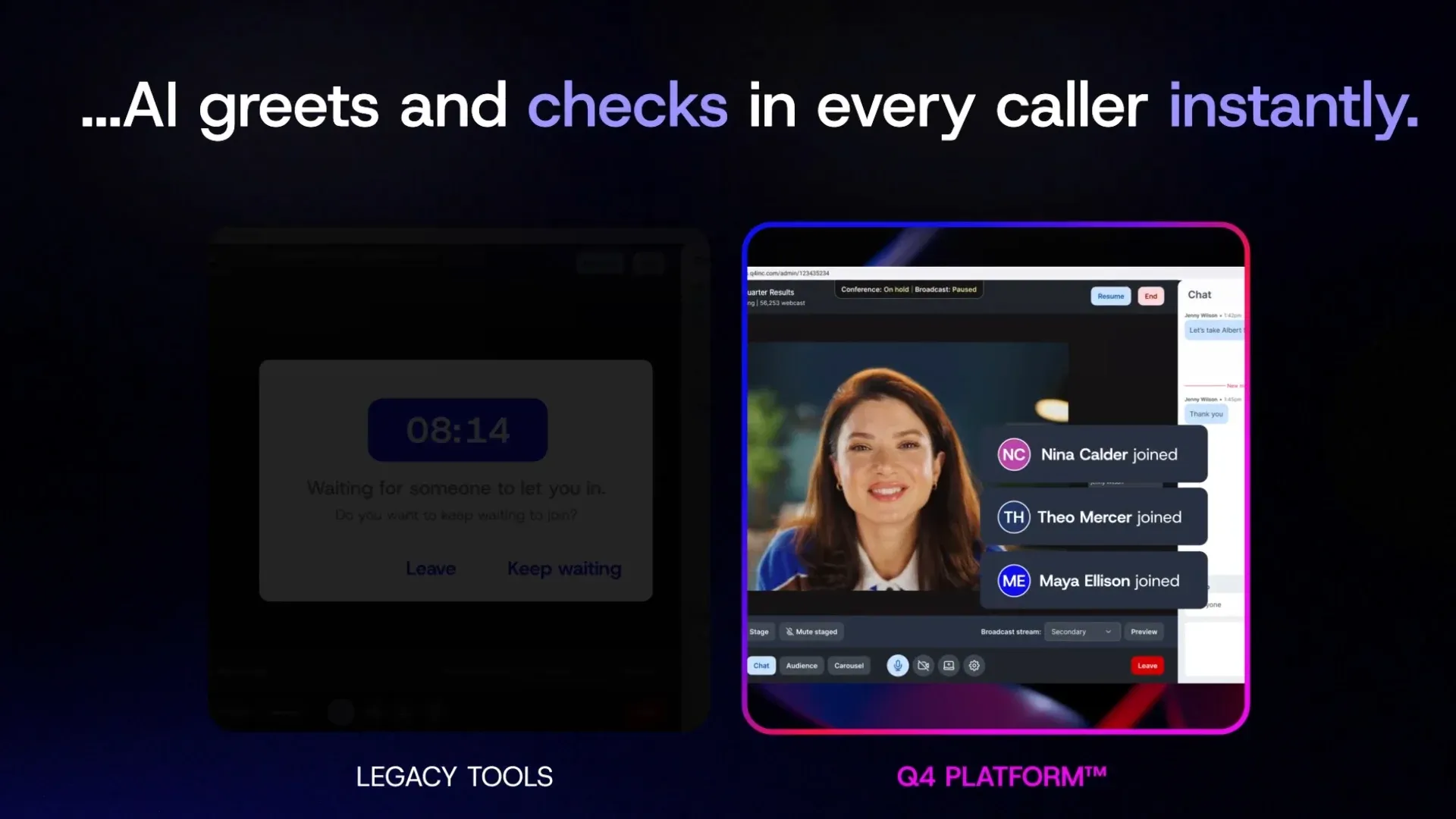
Beyond data intelligence, Q4 is addressing the operational friction inherent in earnings call logistics through its new Automated Caller Intake for Digital Conferencing. The company notes that traditional, operator-assisted registration processes can lead to hold times of 10 to 15 minutes during peak periods, which can frustrate analysts and investors. To mitigate this, Q4 is deploying an AI-powered voice agent designed to process callers simultaneously, aiming to bring automated registration hold times to zero.
This automation utilizes speech-to-text technology and real-time spelling validation to capture participant names and institutional affiliations accurately. In instances where the AI cannot confidently capture information, the system is designed to route the caller to a live concierge. Complementing these logistical updates, the company is also rolling out multi-language IR website management for non-English sites, including French, Spanish, and German. Additional features include verbatim transcript intelligence for precise quote extraction and institutional ownership surveillance, which provides access to 10 years of historical shareholder data to assist in analyzing long-term investor trends.
Key Takeaways
- Q4 has introduced AI-powered Consensus & Public Guidance intelligence to provide near-real-time updates on analyst estimates within five minutes of publication.
- The platform now features Automated Caller Intake, using an AI voice agent to eliminate traditional 10-to-15-minute hold times during earnings call registration.
- New institutional ownership surveillance tools provide IR teams with 10 years of historical shareholder data to track long-term investor trends.
FinanceInsyte's Take
In our view, Q4’s move to integrate AI-driven consensus management and automated telephony represents a calculated attempt to move from being a mere service provider to becoming the central operating system for investor relations. By absorbing the functions of manual data reconciliation and call center logistics, Q4 is targeting the "operational friction" that often plagues IR departments during high-volatility earnings windows. The strategic integration of Virtua Research’s data with real-time sentiment analysis suggests that Q4 recognizes the growing demand for "contextual intelligence"—the ability to see not just what the market thinks, but how that thinking aligns with actual shareholder movement. For institutional finance professionals, the value lies in the reduction of "time-to-insight," though the ultimate success of these tools will depend on the accuracy of the AI's reasoning when interpreting complex analyst revisions.
Questions & Answers
How does the new AI intelligence impact the speed of earnings preparation?
The enhancements allow IR teams to generate pre-earnings consensus summaries in minutes rather than hours. Additionally, newly published market intelligence is integrated into the Q platform within five minutes, providing faster access to shifting analyst expectations.
What specific operational bottleneck is the Automated Caller Intake designed to solve?
It targets the delays caused by traditional, one-at-a-time, operator-assisted registration workflows. These manual processes can result in participant hold times of 10 to 15 minutes during peak earnings periods; the new AI voice agent aims to bring these hold times to zero.
Can the platform correlate analyst sentiment with actual shareholder movements?
Yes. Q4 is positioning its platform to connect "Street expectations" with investor behavior by allowing teams to view market expectations alongside shareholder ownership, trading activity, and past engagement data.
What historical data is available for analyzing investor trends?
Through the new institutional ownership surveillance feature, IR teams can access 10 years of historical shareholder data to assist in the analysis of long-term investor trends.
Source: Q4 Inc