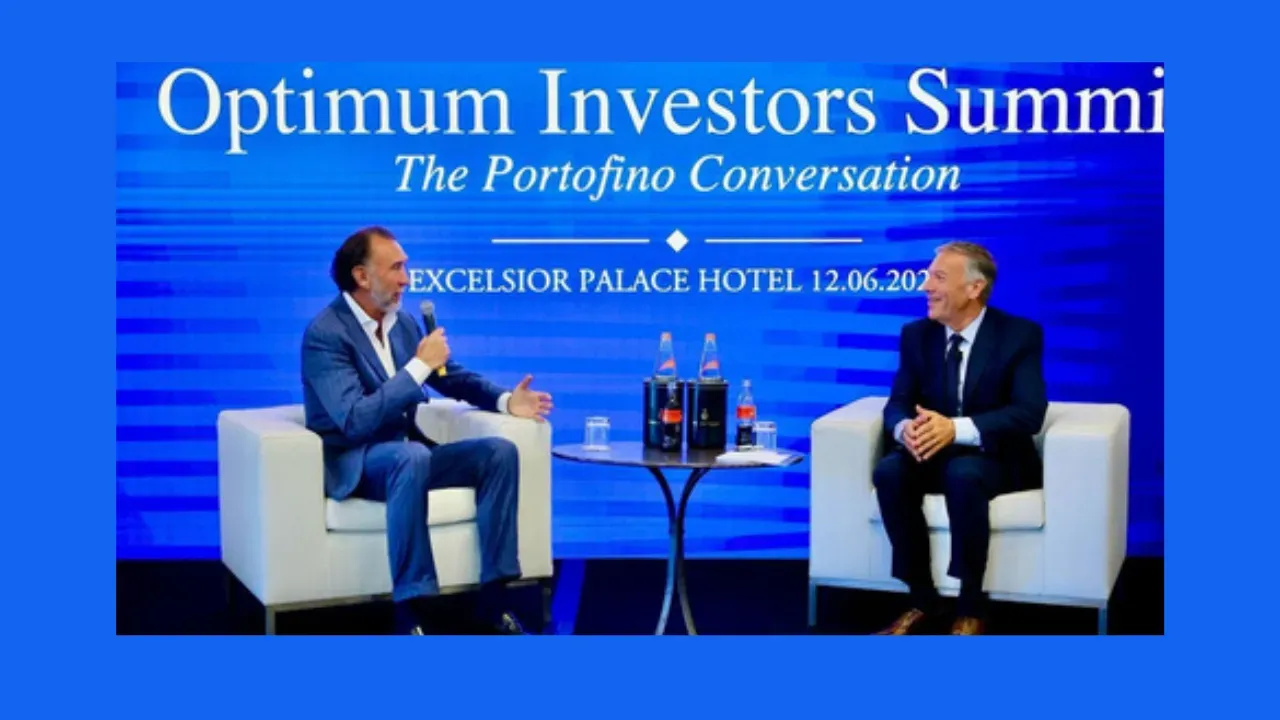
Optimum Asset Management held its inaugural Investor Summit – The Portofino Conversation – on the Italian Riviera, bringing together former U.S. Secretary of State Mike Pompeo, former Italian Prime Minister Matteo Renzi, and senior government, finance and industry leaders. The three‑day event gathered institutional investors, entrepreneurs and policymakers to discuss geopolitical risk, European competitiveness and the outlook for the global economy, a focus of direct relevance to financial‑services executives and investors.
Optimum Asset Management’s Investor Summit in Portofino
The summit, organized by Optimum Asset Management and its Italian partners Alberto Matta, Rodolfo Misitano, Enrico Imbraguglio and Andrea Suriano, convened a “strong participation” of institutional investors—including pension funds—entrepreneurs, government representatives and financial‑market professionals. Moderated by former Prime Minister Silvio Berlusconi spokesman Andrea Ruggeri, the program featured a series of conversations led by Paolo Liguori that examined “the key economic, geopolitical and financial issues reshaping the global landscape.”
Opening remarks were delivered by Mike Pompeo, who provided an “in‑depth analysis of the geopolitical challenges of the 21st century,” focusing on the Middle East, the war in Ukraine, Iran and the growing competition between the West and China. Pompeo warned that “the real strategic challenge is not Russia, but the Chinese Communist Party,” adding that Beijing “represents a systemic threat to the model of liberal democracies and to the economic principles underpinning the Western world.” He also called for deeper Europe‑U.S. security cooperation and greater investment in “technology, cybersecurity, energy and critical infrastructure.”
Italian political figures—including Senator Matteo Renzi, Deputy Minister Edoardo Rixi, Undersecretaries Claudio Durigon and Matilde Siracusano, Liguria President Marco Bucci and Calabria President Roberto Occhiuto—joined the dialogue on European competitiveness, infrastructure, energy and investment prospects. Representatives of Cassa Depositi e Prestiti and Antonio Gozzi, Chairman of Duferco and President of Federacciai, also contributed. Optimum’s partners summed up the event as an “extremely successful” platform for “meaningful dialogue” on economics, growth, geopolitics and competitiveness.
Geopolitical Themes Highlighted by Mike Pompeo
Pompeo’s remarks framed China as the primary systemic risk to Western liberal democracies. He asserted that “Xi Jinping does not believe in private property” and that any business with a Chinese firm is effectively a transaction with the Chinese Communist Party. The former secretary of state also stressed that “every nation must do more to protect its sovereignty—not only in military terms, but also in technology, cybersecurity, energy and critical infrastructure.”
On the Middle East, Pompeo expressed “strong doubts about the possibility of normalizing relations with Tehran,” stating that “the Iranians have violated every agreement they have signed in the past” and that the regime “must change.” He warned that if “in two or three years, we still have the same government in Tehran with an active nuclear programme once again, we will have missed a historic opportunity.”
These statements underscored the summit’s focus on risk assessment for investors, particularly those with exposure to emerging‑market sovereign debt, energy supply chains and technology assets that could be affected by heightened U.S.–China tensions or sanctions on Iran.
European Competitiveness and Infrastructure Discussions
Renzi, Rixi and other European officials used the forum to outline priorities for “European competitiveness, infrastructure, energy, investments and the growth prospects of the global economy.” While specific policy proposals were not detailed, the presence of high‑level regional leaders signaled a coordinated effort to attract capital to European projects.
The summit also highlighted the role of public‑private partnerships, with Cassa Depositi e Prestiti and industry groups such as Federacciai represented. Their participation suggests an intent to mobilize institutional capital for strategic sectors, including energy transition and advanced manufacturing, areas of growing interest to pension funds and insurance investors seeking long‑term, inflation‑linked returns.
Optimum Asset Management’s own profile reinforces this context: the firm manages more than €1.6 billion across private‑equity real estate, real‑asset and cross‑border investments, with a portfolio that includes roughly 30 assets in Berlin and Potsdam (jointly with Blackstone) and over €400 million in U.S. life‑science and technology projects. The summit therefore served both as a showcase of Optimum’s network and as a venue for aligning investor appetite with European strategic objectives.
Key Takeaways
- The inaugural Optimum Investors Summit – The Portofino Conversation – gathered former U.S. Secretary of State Mike Pompeo, former Italian Prime Minister Matteo Renzi and senior government, finance and industry leaders for three days of dialogue on geopolitics and European competitiveness.
- Pompeo warned that “the real strategic challenge is not Russia, but the Chinese Communist Party,” and called for increased Europe‑U.S. cooperation on technology, cybersecurity, energy and critical infrastructure.
- European officials, including Renzi and Deputy Minister Edoardo Rixi, used the summit to discuss “European competitiveness, infrastructure, energy, investments and the growth prospects of the global economy,” signaling a push for greater institutional capital into strategic projects.
FinanceInsyte's Take
The Portofino Conversation illustrates how private‑equity firms are positioning themselves as conveners of high‑level geopolitical and economic discourse, a trend that may shape investors’ risk‑assessment frameworks. While the summit highlighted systemic concerns about China and Iran, concrete policy outcomes remain undefined, leaving financial executives to monitor how these narratives translate into regulatory or investment‑climate shifts in Europe. Buyers should watch for follow‑up initiatives that link the summit’s strategic themes to tangible funding pipelines or public‑policy incentives.
Source: Businesswire