


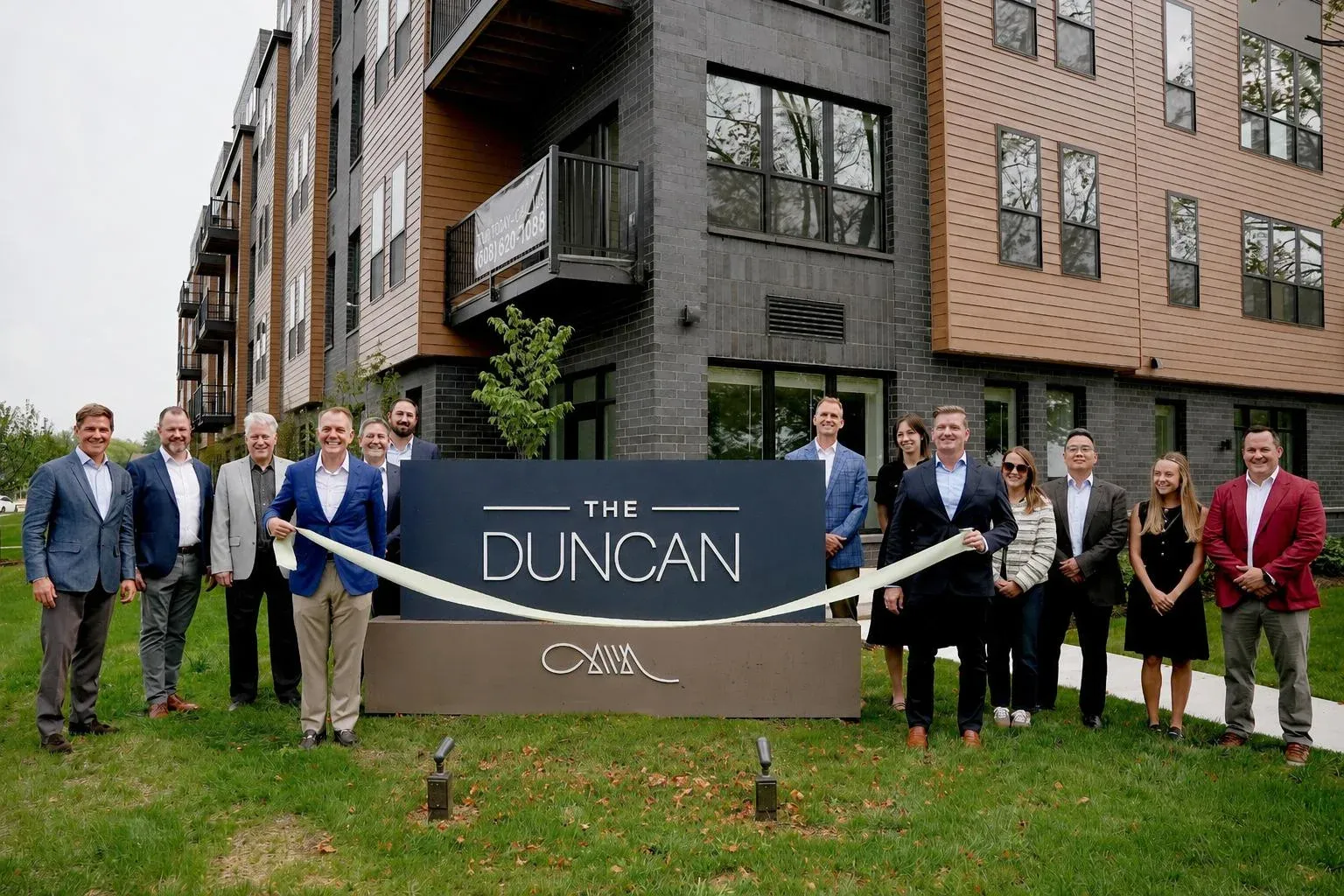
Institutional capital is increasingly targeting high-demand urban infill markets to address significant housing shortages, as evidenced by the recent completion of The Duncan in Madison, Wisconsin. This 309-unit multifamily community, situated on 8.2 acres along the city's Isthmus, represents a strategic deployment of capital within a federally-designated Qualified Opportunity Zone. Developed through a partnership between Clarion Partners, Vermilion Development, and Quartz Lake Capital, the project aims to capture the growing residential demand in a city projected to add more than 9,300 households by 2030. The opening marks a significant milestone for the equity partners, who are positioning the asset to leverage its proximity to Lake Mendota and downtown Madison.
The Duncan Asset and Capital Structure
The Duncan officially opened its doors following a ribbon-cutting ceremony where Madison Mayor Satya Rhodes-Conway proclaimed August 13, 2026, “The Duncan Day.” The development is a multi-partner effort involving Clarion Partners, a subsidiary of Franklin Templeton, Vermilion Development, and Quartz Lake Capital acting as equity partners. The project’s financial architecture was supported by CIBC as the lender, with JLL serving as the intermediary to source both the project’s equity and debt.
The physical asset comprises a mix of studio, one-, two-, and three-bedroom residences, including townhome configurations. To appeal to modern urban dwellers, the developers integrated several high-end amenities, including two fitness centers, coworking and breakout spaces, a pet spa, and two rooftop terraces overlooking Lake Mendota. Beyond lifestyle features, the project incorporates specific sustainability measures, such as ENERGY STAR appliances, occupancy sensors in common areas, and WaterSense plumbing fixtures. The construction was managed by McShane Construction Company, marking their first project collaboration with Vermilion Development. Greystar has been appointed to handle property management, while Potter Lawson served as the architect for the 8.2-acre site located at 1625 Lock Lane.
Madison Housing Demand and Opportunity Zone Strategy
The timing of this delivery aligns with aggressive municipal growth targets in Madison. The city has established a goal of creating 15,000 new homes by 2030, a necessity driven by projections that the area will see an influx of approximately 18,400 people over the next several years. By locating The Duncan within a Qualified Opportunity Zone (QOZ), the investment group is utilizing a specific tax-incentivized framework designed to encourage long-term capital investment in distressed or under-resourced communities.
Clarion Partners is actively scaling its presence in these specialized zones, reporting ownership or investment in over 170 properties located within QOZs as of June 30, 2026. This project illustrates a broader trend where institutional managers seek to blend high-amenity, "live/work/play" residential products with the fiscal advantages offered by federal opportunity zone designations. The Duncan's location near Tenney Park and the waterfront provides the "unparalleled lakeside setting" that the partners believe will drive residential absorption in a competitive market. As leasing operations commence, the project serves as a test case for how institutional-grade multifamily assets can be successfully integrated into high-growth, high-demand municipal environments through complex public- and private-sector collaboration.
Key Takeaways
- The Duncan is a 309-unit multifamily community located within a federally-designated Qualified Opportunity Zone in Madison, Wisconsin.
- The project was financed through a partnership of Clarion Partners, Vermilion Development, and Quartz Lake Capital, with CIBC acting as the lender.
- Madison is targeting the creation of 15,000 new homes by 2030 to accommodate a projected increase of 18,400 residents.
FinanceInsyte's Take
In our view, The Duncan is a textbook example of how institutional investors are navigating the intersection of urban housing shortages and specialized tax incentives. By deploying capital into a Qualified Opportunity Zone, the partnership of Clarion, Vermilion, and Quartz Lake is not merely building housing; they are optimizing for long-term tax efficiency while targeting a high-barrier-to-entry submarket. The decision to focus on high-amenity, "lifestyle-centric" units—complete with coworking spaces and lakeside views—suggests a belief that the Madison market can support premium rents driven by professional demographics. Furthermore, the involvement of major players like CIBC and JLL underscores the institutional maturity of this development. This project signals that even in a complex interest rate environment, the combination of municipal growth mandates and federal tax frameworks remains a potent driver for large-scale multifamily development.
Questions & Answers
How does the Qualified Opportunity Zone designation impact the project's financial profile?
While specific tax yields were not disclosed, the location within a federally-designated Qualified Opportunity Zone allows the equity partners to leverage specific tax incentives designed to encourage long-term investment in designated areas, potentially enhancing the after-tax returns on the capital deployed.
What is the projected housing demand in the Madison, Wisconsin market?
The city of Madison is projecting the addition of more than 9,300 households—approximately 18,400 people—by 2030, and has set a broader municipal goal of creating 15,000 new homes to meet this growth.
Who are the primary institutional stakeholders involved in the financing and management of The Duncan?
The equity partners include Clarion Partners, Vermilion Development, and Quartz Lake Capital. CIBC provided the lending, JLL sourced the debt and equity, McShane Construction served as the general contractor, and Greystar is the designated property manager.
What specific sustainability features were integrated into the development's design?
The project incorporates ENERGY STAR appliances, occupancy sensors in applicable common areas, efficient natural-gas water heating, and WaterSense plumbing fixtures to enhance energy and water efficiency.
Source: Businesswire


