
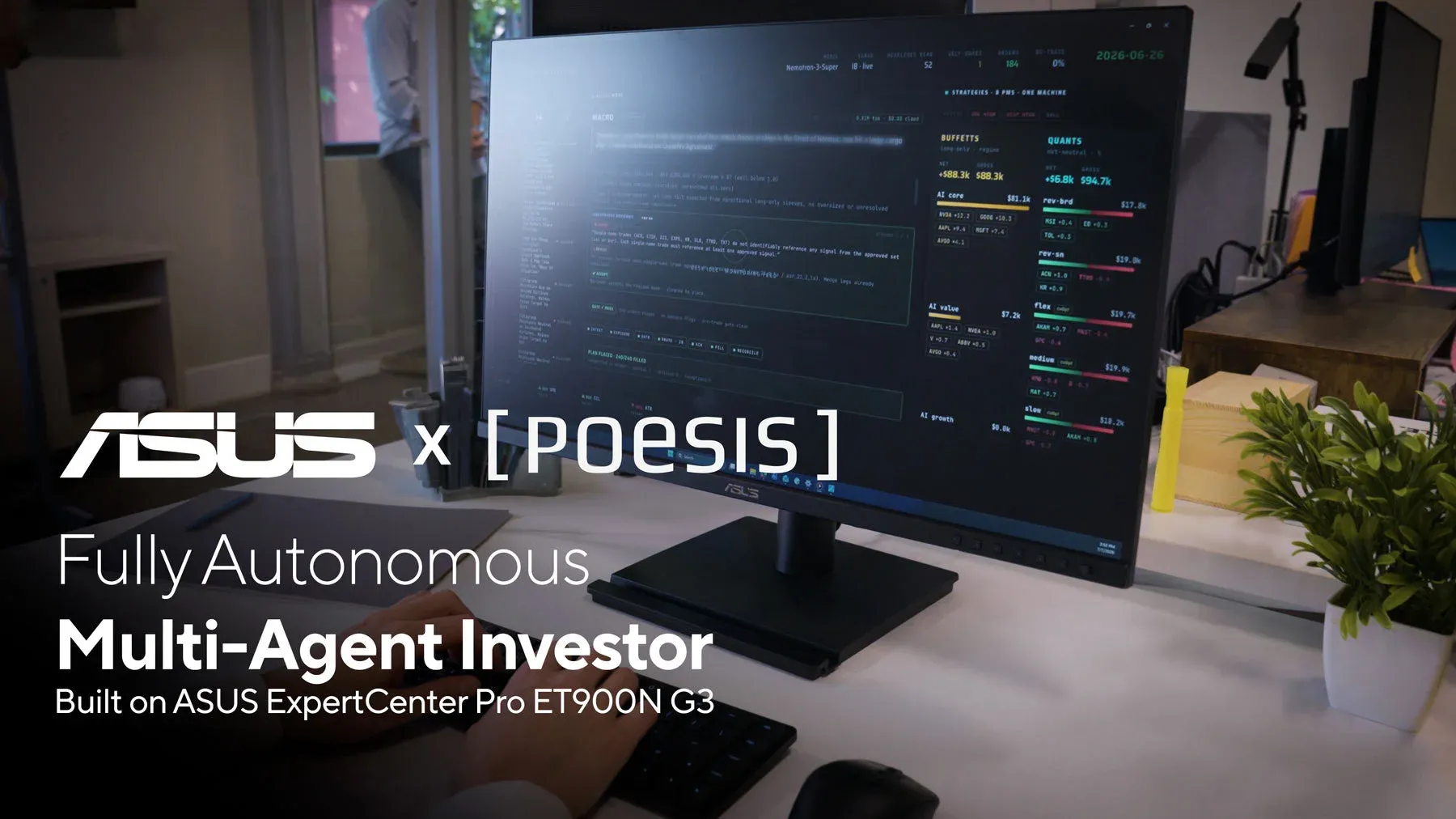
The push toward decentralized, high-performance financial intelligence has reached a new milestone through a successful week-long experiment involving ASUS and Poesis. By deploying agentic AI to trade in live financial markets using actual capital, the collaboration demonstrates that autonomous investment workflows can function entirely on local hardware. This test moves the conversation from theoretical AI models to the practical deployment of independent agents capable of conducting research, managing risk, and executing trades without relying on external cloud-based infrastructure.
ASUS and Poesis Execute Local Agentic AI Trading
The experiment utilized the ASUS ExpertCenter Pro ET900N G3, a deskside supercomputer built on the NVIDIA DGX Station platform. Powered by the NVIDIA GB300 Grace Blackwell Ultra Desktop Superchip, the hardware provided up to 20 petaFlops of AI performance and 748GB of coherent memory. This localized setup allowed Poesis to run a multi-agent AI workflow on a single machine, managing the entire lifecycle of a trade—from initial investment research to risk management and final execution—within predefined mandates.
Poesis, an AI-native asset manager led by former Capital Group partner Alex Popa and former Goldman Sachs machine learning head Charles Elkan, used this local environment to prove that agentic systems can operate continuously in live markets. The results suggest that the heavy computational requirements of autonomous trading do not necessitate a permanent dependence on cloud-based AI infrastructure, provided the local hardware possesses sufficient density and memory coherence to handle complex, multi-agent workflows in real-time.
Localized Computing for Autonomous Asset Management
This collaboration highlights a strategic shift in how financial institutions might approach the deployment of agentic AI. By moving workflows from the cloud to a deskside supercomputer, the experiment addresses potential concerns regarding latency, data privacy, and infrastructure reliability. The ASUS ExpertCenter Pro ET900N G3 serves as a proof of concept for "enterprise-to-edge" AI, where sophisticated financial models are processed at the point of use rather than in a centralized data center.
As asset management firms explore the transition from experimental AI to practical, live-market deployment, the ability to run high-performance models locally becomes a critical differentiator. The Poesis test indicates that the next generation of autonomous investment strategies may rely on specialized, high-density hardware to maintain the speed and autonomy required for real-world trading environments. This development signals a growing interest in localized, high-performance computing as a foundational layer for the future of agentic, AI-led investment strategies.
Key Takeaways
- ASUS and Poesis successfully completed a week-long experiment using agentic AI to trade in live financial markets with live capital.
- The workflow ran locally on the ASUS ExpertCenter Pro ET900N G3, powered by the NVIDIA GB300 Grace Blackwell Ultra Desktop Superchip.
- The hardware utilized in the test delivers up to 20 petaFlops of AI performance and 748GB of coherent memory.
FinanceInsyte's Take
In our view, this experiment is less about the specific hardware and more about the validation of "edge" autonomy in high-stakes finance. By proving that agents can manage research, risk, and execution locally, ASUS and Poesis are challenging the cloud-first hegemony in AI deployment. For institutional players, this suggests a future where proprietary trading algorithms can be shielded from cloud-based vulnerabilities and latency issues by utilizing high-density, deskside supercomputing. This move toward localized, agentic intelligence could redefine the infrastructure requirements for the next wave of AI-native asset managers seeking to deploy autonomous strategies in live, volatile markets.
Questions & Answers
How does the ASUS hardware support complex AI trading workflows?
The ASUS ExpertCenter Pro ET900N G3 utilizes the NVIDIA GB300 Grace Blackwell Ultra Desktop Superchip, providing 20 petaFlops of AI performance and 748GB of coherent memory, which enables the local execution of multi-agent workflows.
What specific trading functions were performed by the AI agents?
The agentic AI agents autonomously conducted investment research, managed risk, and executed trades using live capital while operating within predefined mandates.
What is the strategic significance of running these agents locally?
Running agents locally on a deskside supercomputer demonstrates that autonomous investment workflows can function in live markets without a dependence on cloud-based AI infrastructure.
Who are the key figures behind the Poesis asset management firm?
Poesis was founded by Alex Popa, a former partner and portfolio manager at Capital Group, and Charles Elkan, the former Global Head of Machine Learning at Goldman Sachs.
Source: Businesswire