
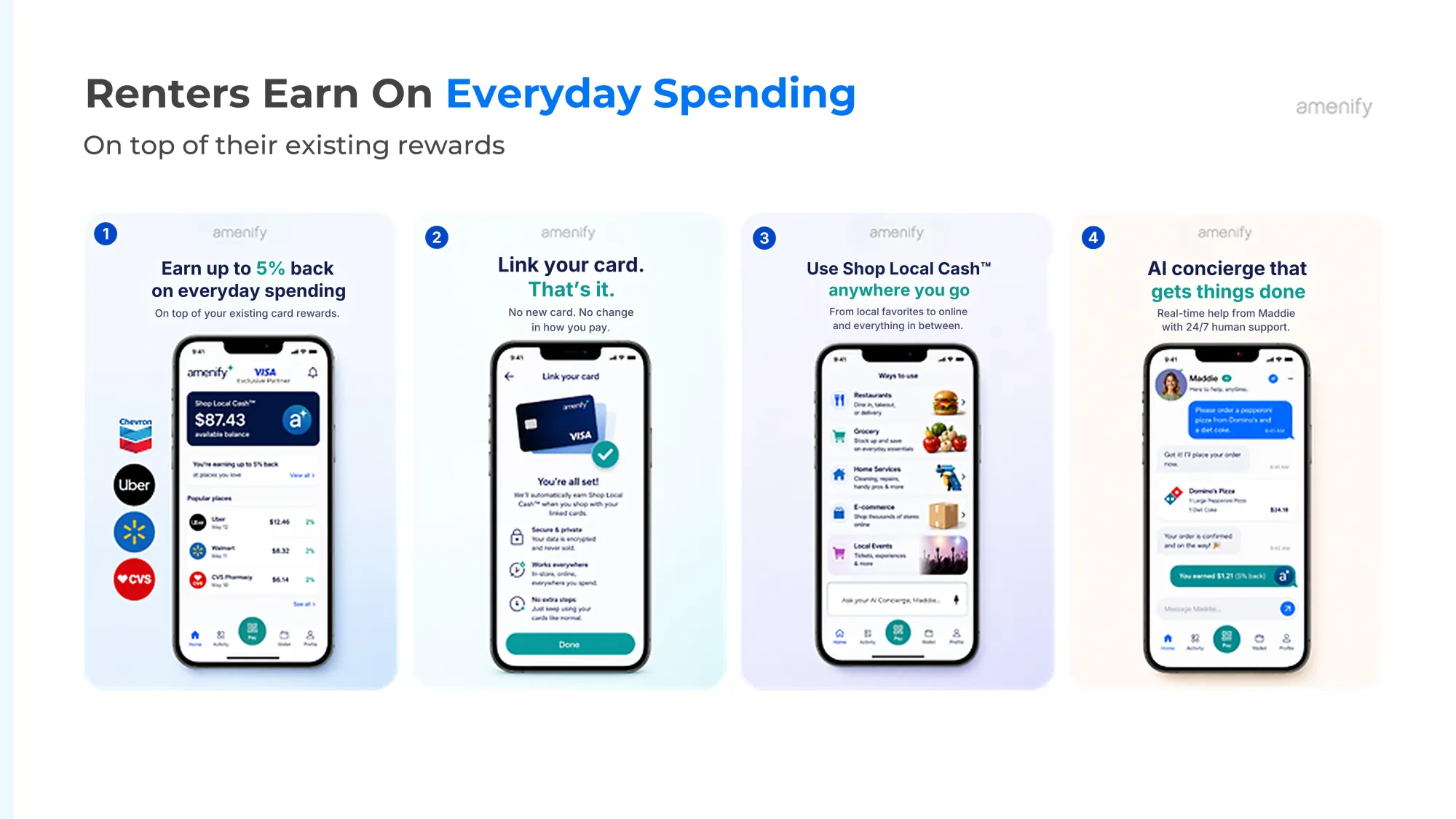
Amenify is attempting to capture a larger share of household wallet spend by integrating card-linked rewards directly into its resident commerce ecosystem. The San Francisco-based platform has launched a beta program that allows eligible residents to connect existing credit or debit cards to earn up to 5.0% back on specific local expenditures, such as gas and groceries. By leveraging new bank and account linking technology—currently testing with Plaid—the company aims to bypass the friction of traditional loyalty programs. This strategic move seeks to transform residential living spaces into active commerce hubs, targeting an audience of 20 million residents across its broader property-partner network in the coming quarters.
Amenify Card-Linked Rewards Beta Rollout
The newly announced beta program utilizes a card-agnostic infrastructure, meaning residents can link any credit or debit card from any major network or financial institution, including banks and fintechs. This approach allows users to retain their "top-of-wallet" card and continue earning existing rewards from their primary issuers, while Amenify issues additive "Shop Local Credits." These credits can be applied toward local and online merchants, including food, grocery, home services, and e-commerce goods for the home. The company is currently rolling out this beta to thousands of users across the United States.
Technically, the system functions through a seamless integration where residents opt-in to link their accounts, discover eligible merchants via the "Shop Local" feature, and pay as they normally would. The platform eliminates the need for manual receipt uploads or coupon clipping. Beyond the financial incentive, the Amenify app includes a map feature that surfaces participating locations and provides real-time fuel pricing. To support the user experience, the company is pairing the service with 24/7 assistance from an AI concierge and a human care team. This rollout follows a recently announced partnership between Amenify and Visa to develop intelligent resident commerce.
Targeting High-Volume Household Spending
Amenify’s decision to prioritize gas and grocery categories is driven by specific consumer spending data rather than qualitative surveys. The company notes that while American households spend approximately $2.8 trillion annually on everyday categories, groceries and fuel alone account for roughly 62% of that total. This volume exceeds the combined spending of dining, delivery, rideshare, coffee, and health and beauty. By focusing on these high-frequency, high-cost categories, Amenify is positioning its rewards to provide immediate, tangible value to the household budget.
For the merchant side of the ecosystem, the card-linked model is designed to provide what Co-founder and CTO/COO Danish Chopra describes as a "clean, closed-loop record" of attribution. Unlike modeled estimates, this infrastructure aims to provide merchants with verified data on which rewards actually drove specific purchase activity. The platform intends to use its property partnerships to reach residents through personalized offers, geolocation, and retargeting. This creates a specialized commerce channel that connects merchant campaigns directly to eligible purchase activity within the residential environment, leveraging Amenify's existing relationships with property management software partners.
Key Takeaways
- Amenify has launched a card-linked rewards beta offering up to 5.0% back on qualifying local spend, specifically targeting gas and grocery categories.
- The program is designed to be card-agnostic, allowing residents to link existing credit or debit cards from any major network or financial institution to earn additive credits.
- The company plans to expand the service to a target audience of 20 million residents across its property-partner network in the coming quarters.
FinanceInsyte's Take
In our view, Amenify is executing a sophisticated play to intercept high-velocity transaction data at the intersection of fintech and PropTech. By utilizing card-linking rather than forcing users toward a proprietary payment method, they are removing the primary barrier to adoption: consumer inertia. This "additive" reward model is a strategic masterstroke for user acquisition, as it promises value without requiring the user to abandon their existing banking relationships or loyalty ecosystems.
Furthermore, the emphasis on "attributable" commerce is a direct signal to merchants who are increasingly frustrated by the lack of transparency in digital advertising. If Amenify can successfully prove that their closed-loop data provides superior ROI compared to traditional modeled attribution, they could secure a dominant position in the residential commerce vertical. The scalability of this model depends entirely on the depth of their property management partnerships and the seamlessness of their Plaid-powered integrations.
Questions & Answers
How does the Amenify reward structure affect existing bank loyalty programs?
The Amenify program is designed to be additive. Because the "Shop Local Credits" are issued by Amenify rather than the card issuer, residents continue to earn whatever cash back or points their existing credit or debit cards already provide.
What specific consumer spending data informed the selection of gas and grocery categories?
Amenify identified that groceries and fuel account for approximately 62% of the $2.8 trillion spent annually by American households on everyday categories, outstripping the combined spend of dining, delivery, rideshare, coffee, and health and beauty.
What technical infrastructure supports the card-linking process?
The platform is powered by new bank and account integration, which is currently undergoing testing with Plaid. This allows for a card-agnostic experience where users can link their existing cards without changing their payment habits.
How does the platform provide value to participating merchants?
Amenify provides merchants with a verified, closed-loop record of purchase activity. This allows merchants to see exactly what a reward drove, rather than relying on modeled estimates, and enables them to reach residents via geolocation, SMS, and personalized offers.
Source: Amenify