


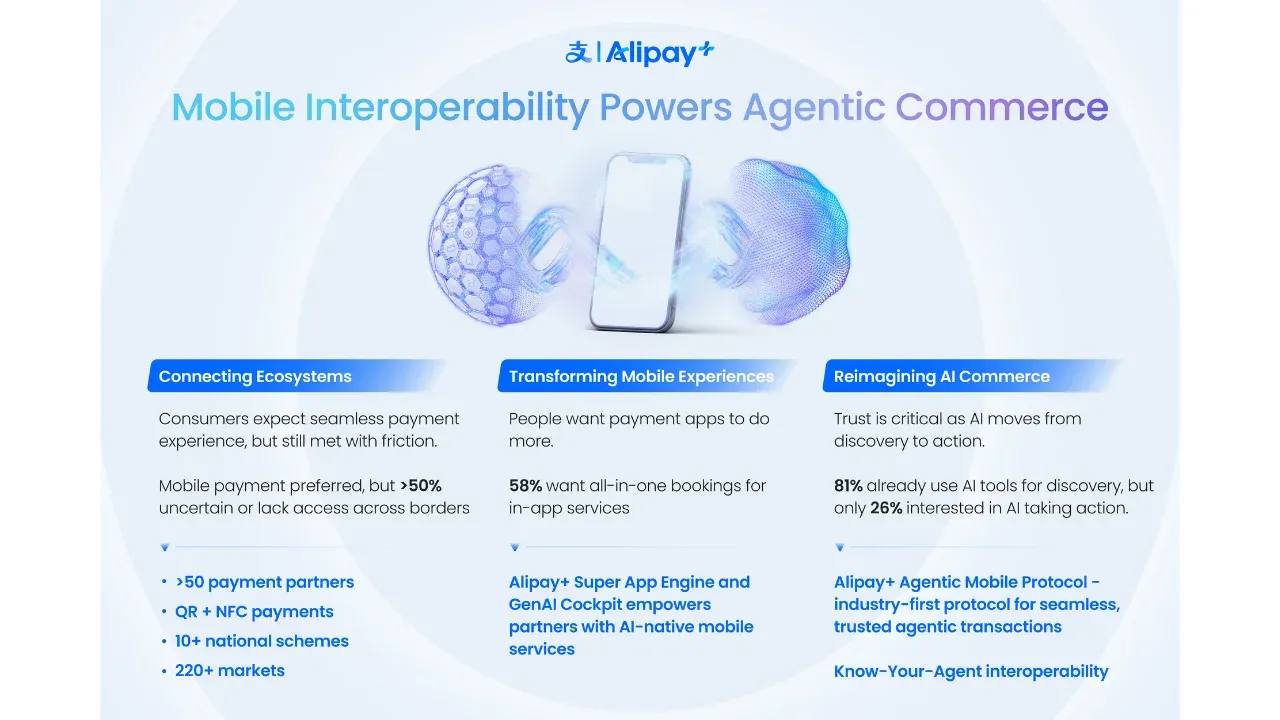
The rapid evolution of consumer spending habits is outstripping the current capacity of global commerce infrastructure, creating a significant "commerce digitalisation gap" that threatens seamless cross-border transactions. A new joint report from Ant International’s Alipay+ and S&P Global reveals that while consumers are increasingly mobile-first, they remain hindered by fragmented payment ecosystems and a lack of trust in autonomous technologies. Surveying 6,000 consumers across nine markets in Asia, Europe, and the US, the study highlights a critical tension: travelers demand integrated, intelligent digital assistance, yet over half of respondents still face uncertainty regarding merchant acceptance or access to preferred payment methods. This friction is forcing one in four travelers to maintain cash reserves as a necessary fallback for international commerce.
Alipay+ and S&P Global Highlight Cross-Border Payment Friction
The transition toward a borderless, mobile-first economy is currently stalled by a lack of interoperability between regional payment standards. According to the report, while 63% of consumers use mobile payments for most transactions while traveling, significant regional divergences persist. Consumers in China, Malaysia, and Thailand show a strong preference for QR-based payments, whereas those in the US, UK, and Germany favor NFC-based, card-linked wallets. This technological mismatch contributes to widespread consumer anxiety; 53% of respondents cited uncertainty regarding merchant acceptance, and 54% reported a lack of access to their preferred payment methods.
Beyond simple transaction failures, the report identifies deep-seated concerns regarding the mechanics of digital finance. Specifically, 62% of consumers expressed worries about transaction security, while 56% cited concerns regarding exchange rates, fees, and unfamiliar terminal processes. These hurdles extend into the pre-trip phase, with 54% of consumers reporting difficulties using preferred payment methods during initial bookings. This fragmentation is particularly evident in the shift toward hyper-local spending, where food and beverage (67%) and local attractions (66%) have seen the largest increases in traveler expenditure, often at small local shops rather than traditional malls.
The Divergence Between AI Discovery and Agentic Execution
As financial institutions and fintechs look toward artificial intelligence to drive the next wave of commerce, a significant "trust gap" is emerging between exploration and transaction. The Alipay+ and S&P Global data shows that AI adoption is highly successful in the planning stages, with 81.3% of consumers already utilizing AI tools for travel discovery and destination research. However, as the technology moves closer to high-stakes financial actions, consumer confidence drops precipitously. While 73.2% of consumers are open to using AI for hotel or flight bookings, only 26% express interest in allowing AI to manage payments or autonomous decision-making.
This hesitation is largely driven by privacy and control concerns. The report notes that 43% of global consumers express privacy concerns regarding AI, and 43% hesitate to use AI assistants because they prefer to manage their own planning. Furthermore, 32% of respondents indicated a continued preference for human advice over automated systems. To address this, Ant International is positioning its technical suite—including the Alipay+ Agentic Mobile Protocol (AMP) and the Alipay+ Super App Engine (ASAP 2.0)—to help partners build more secure, AI-native solutions. The goal is to transition from simple digital payments to "agentic commerce," where AI can assist with bookings, refunds, and real-time guidance while maintaining user control.
Key Takeaways
- Over 50% of consumers report uncertainty regarding merchant acceptance or lack of access to preferred payment methods during cross-border travel.
- While 81.3% of consumers use AI for travel discovery, only 26% are interested in using AI for direct payments or autonomous decision-making.
- Alipay+ currently connects 2 billion user accounts across 50 global payment partners to merchants in more than 220 destination markets.
FinanceInsyte's Take
In our view, the findings from Alipay+ and S&P Global signal that the next battleground in fintech is not merely about payment speed, but about the depth of ecosystem integration and the establishment of "algorithmic trust." The data suggests that the industry is moving toward a bifurcated model: highly efficient, AI-driven discovery paired with a cautious, human-centric execution layer. For institutional players and digital wallet providers, the strategic imperative is clear. Simply offering a digital gateway is no longer sufficient; providers must solve the interoperability crisis between QR and NFC ecosystems to capture the growing hyper-local spending segment. Furthermore, the massive gap between AI discovery (81.3%) and AI execution (26%) represents a significant commercial opportunity for firms that can implement robust, transparent privacy frameworks. The winners will be those who can bridge the "agentic gap" by making AI an assistant rather than a replacement for consumer agency.
Questions & Answers
How does the current fragmentation of payment methods impact consumer behavior in cross-border travel?
The fragmentation causes significant friction, leading 53% of consumers to worry about merchant acceptance and 54% to struggle with accessing preferred payment methods. This uncertainty is substantial enough that one in four travelers continues to carry cash as a fallback to mitigate the risk of digital payment failure.
What are the primary drivers for consumers moving toward integrated mobile wallet ecosystems?
Consumers are seeking consolidation to manage the complexity of travel. Key drivers include the desire for integrated services like restaurant reservations (61%) and all-in-one booking (58%), as well as financial incentives such as rewards and cashback (52%), improved FX rates (51%), and expense tracking (50%).
Why is there a significant drop in consumer interest when AI moves from planning to payment?
The decline is driven by a lack of trust and a desire for autonomy. While AI is widely used for discovery, 43% of consumers have privacy concerns, and many prefer to maintain personal control over their bookings and financial transactions rather than delegating them to an autonomous agent.
What technical solutions is Ant International proposing to facilitate "agentic commerce"?
Ant International has introduced several tools to help wallet partners evolve, including the Alipay+ Agentic Mobile Protocol (AMP)—an open-source framework for mobile device payments—the Alipay+ Super App Engine (ASAP 2.0), the GenAI Cockpit, and the Voyager AI travel agent.
Source: Businesswire


